WRITE THE ROMANCE.
STOP FIGHTING THE AI.
Turn one romance idea into a complete 8,000–10,000 word first draft in three focused days, with a story-first system built specifically for writing fiction with AI.
You bring the idea.
Romance Reactor helps you build the story.
Then AI helps you draft it — in your voice, not its own.
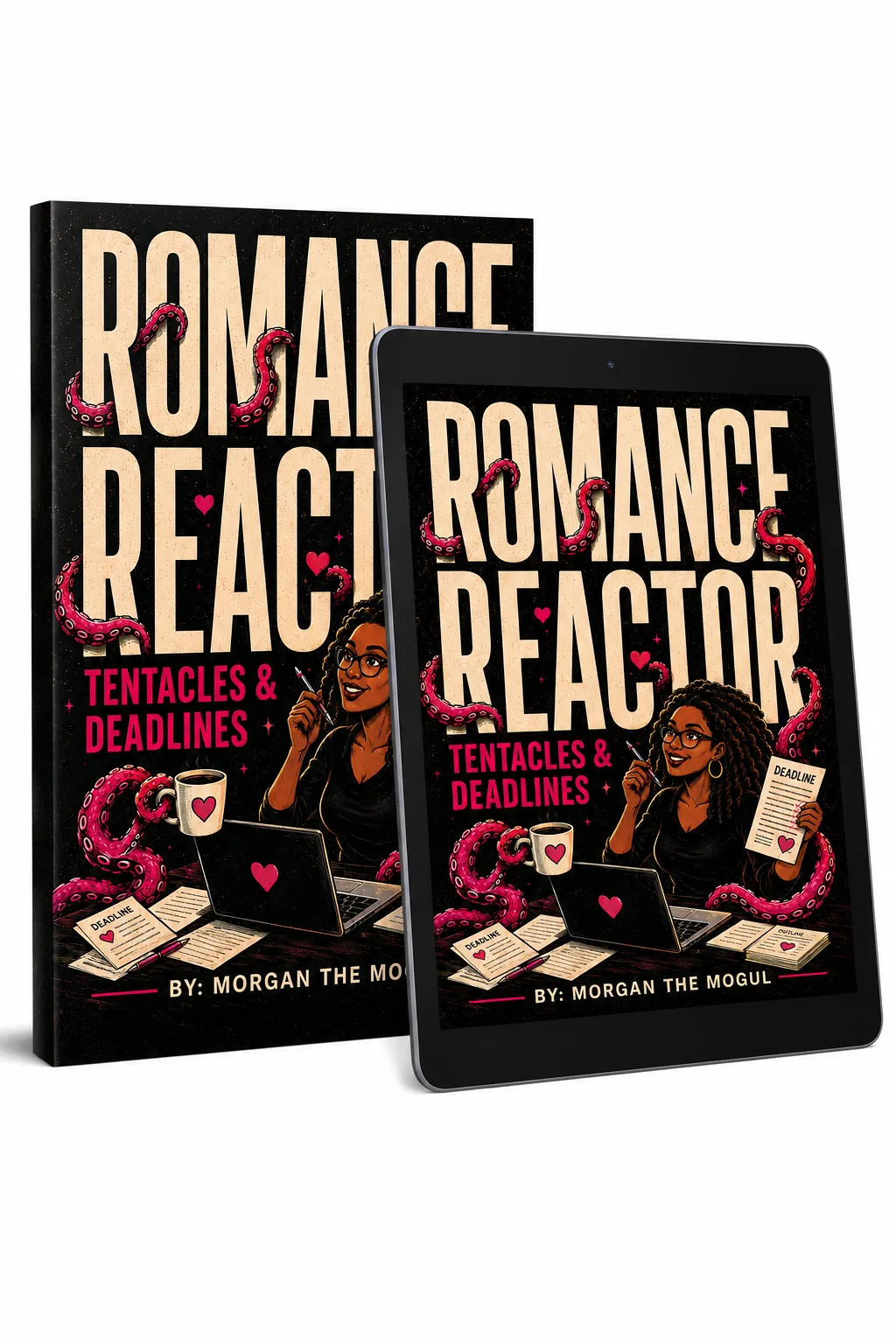
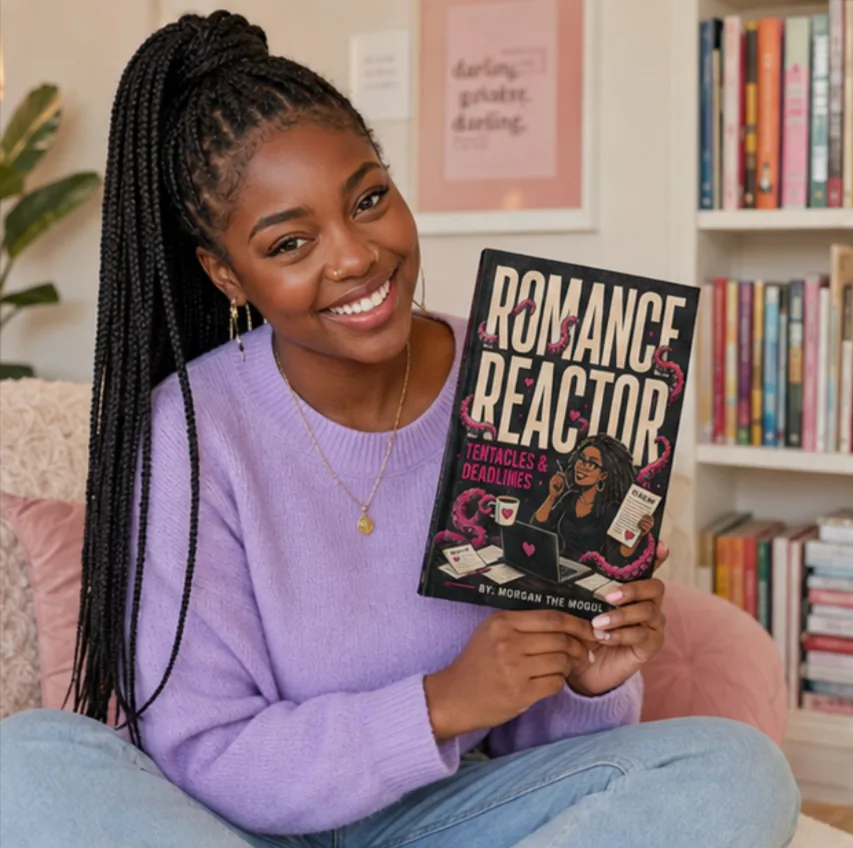
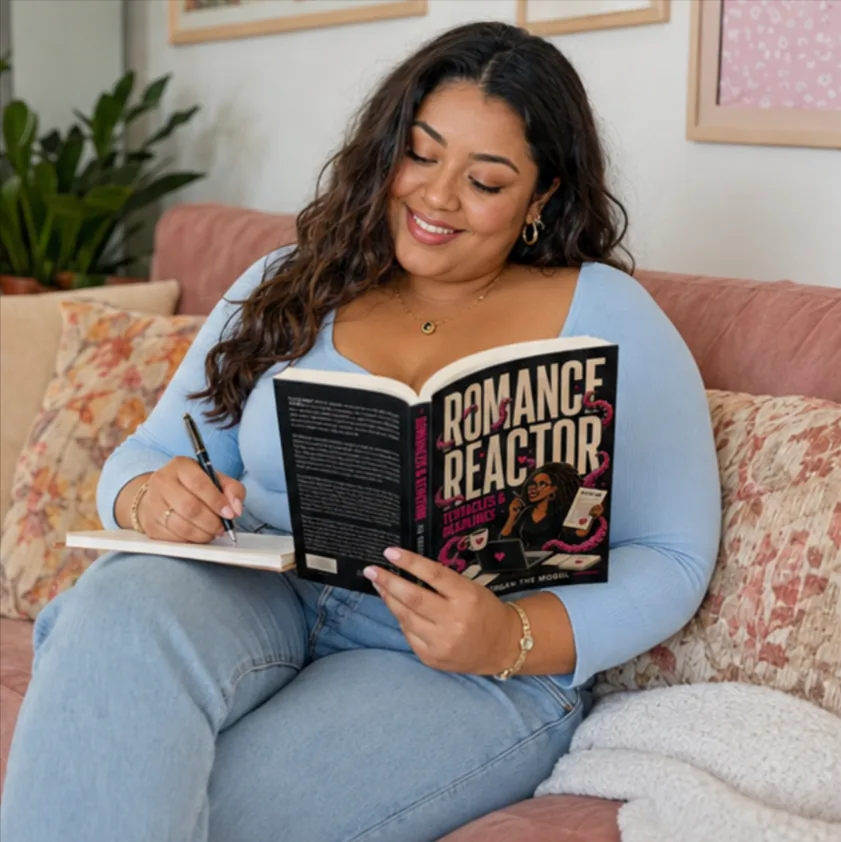
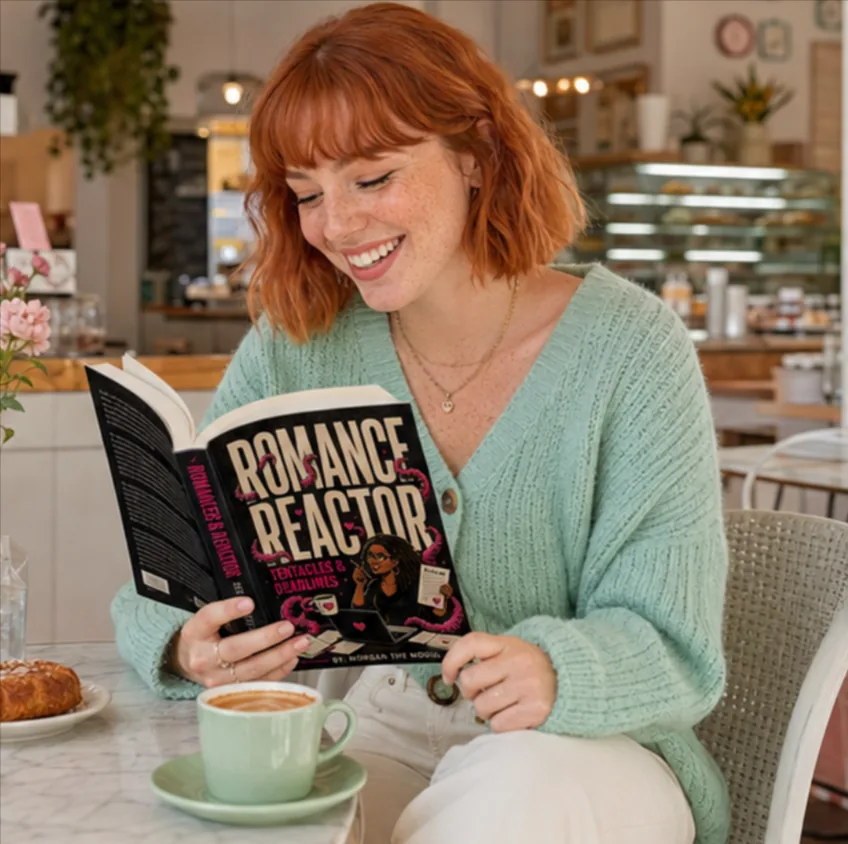
STOP COLLECTING
CHAPTER ONES.
You don't need another story idea. You don't need a 14-hour craft course. You need one short, structured win that proves you can get all the way to THE END.
Romance Reactor is designed for the writer who has ideas everywhere, has experimented with AI writing, and wants one structured win that proves she can finish.
THE OPENING IS GOOD.
THEN THE STORY GOES FLAT.
AI can generate pages fast. The hard part is getting those pages to connect into a romance that actually builds, escalates, and lands.
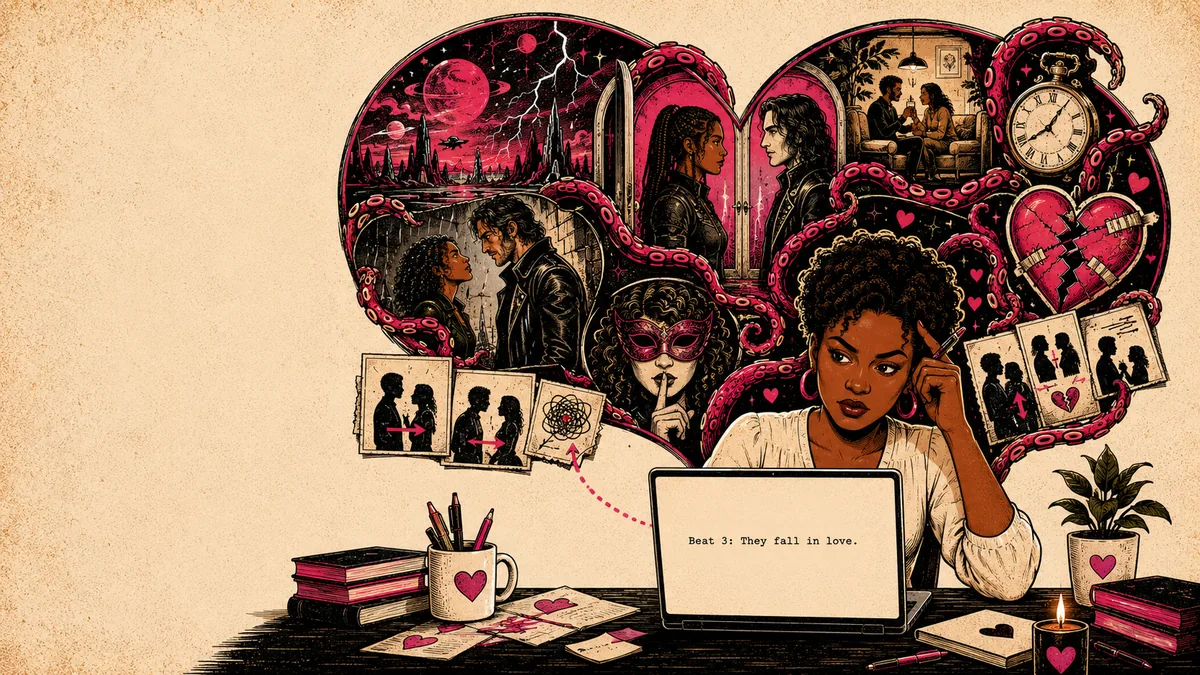
Your AI doesn't.
IT JUST WASN'T BUILT TO EXPLAIN YOUR ENTIRE STORY TO AN AI.
Traditional frameworks give you the major story landmarks. But the human writer is silently carrying the connective tissue AI never automatically gets:
- Emotional logic
- Relationship history
- Character motivation
- Cause and effect
- Setup/payoff relationships
- How your prose actually sounds
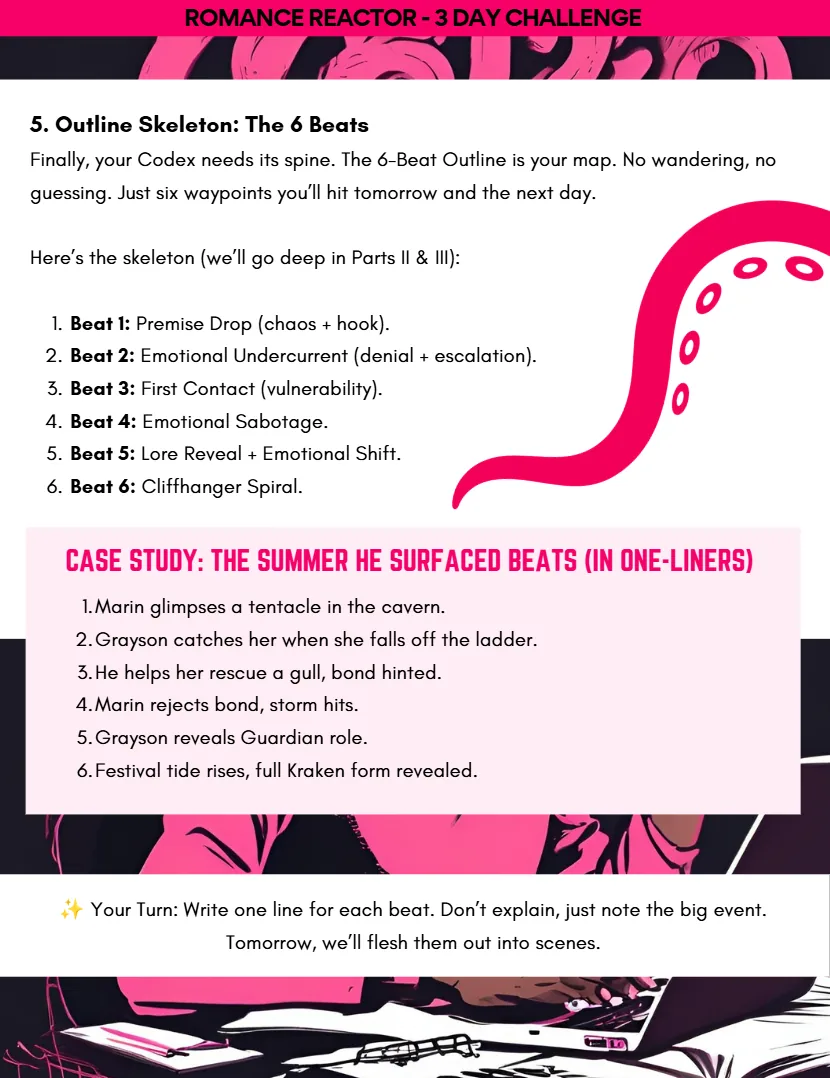
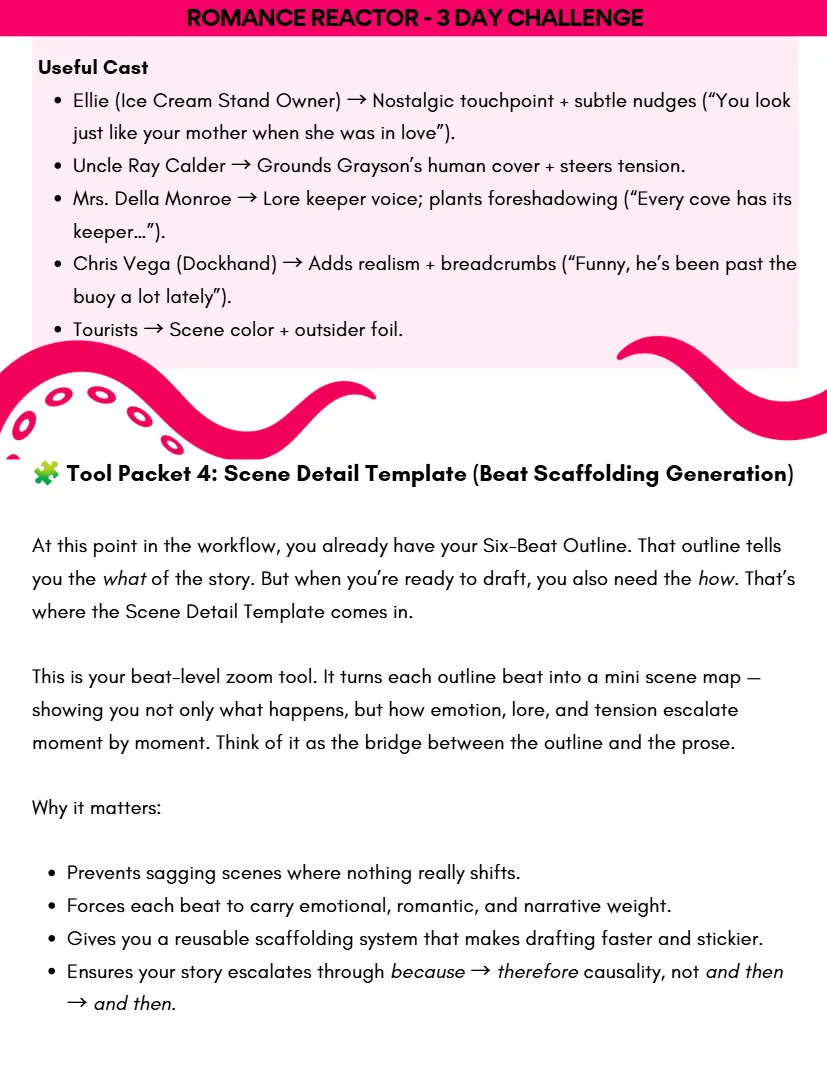
FILL IN WHAT THE BEAT SHEET LEAVES UNSAID.
Build the story before drafting.
Clarify the premise, characters, world, romantic movement — and your Voice Card — first.
Give AI the missing context.
Not just what happens, but the active pressure, the emotional shifts, cause and effect, and story consequences that make the scene belong to this couple.
Draft through causality.
Choice creates consequence. Consequence changes the relationship. The changed relationship creates the next pressure.
A REAL WRITING SYSTEM.
NOT A PILE OF PROMPTS.
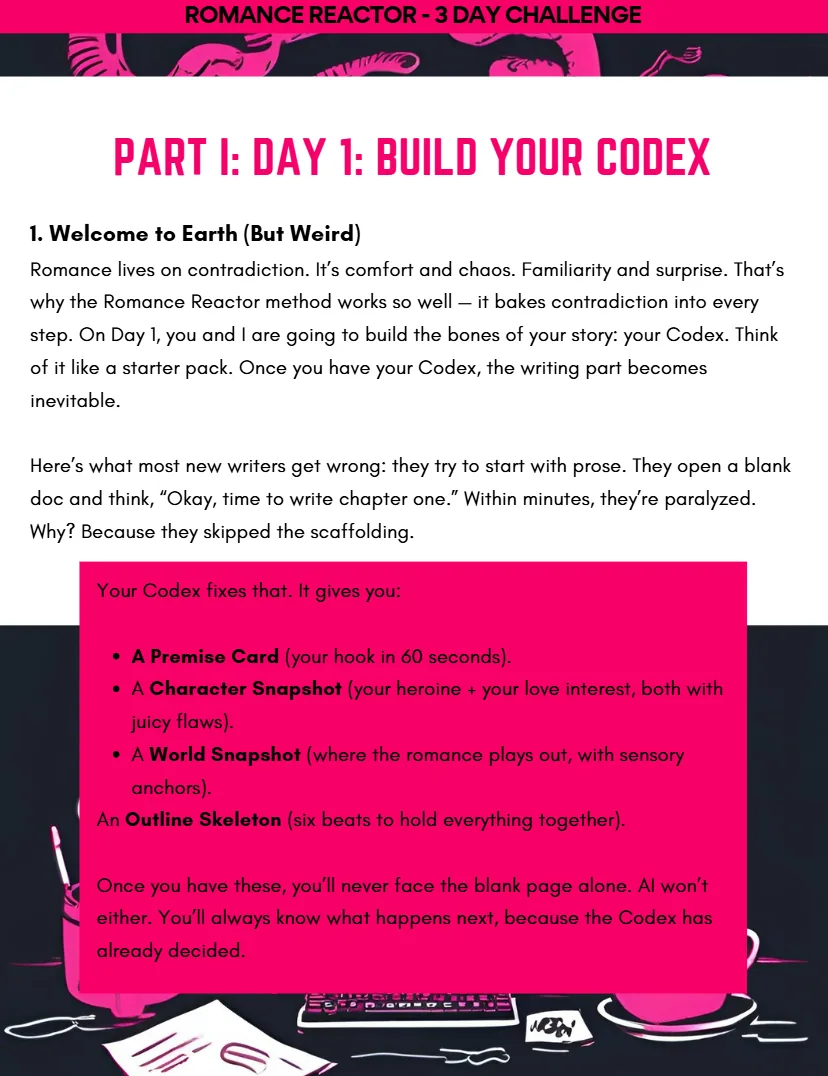
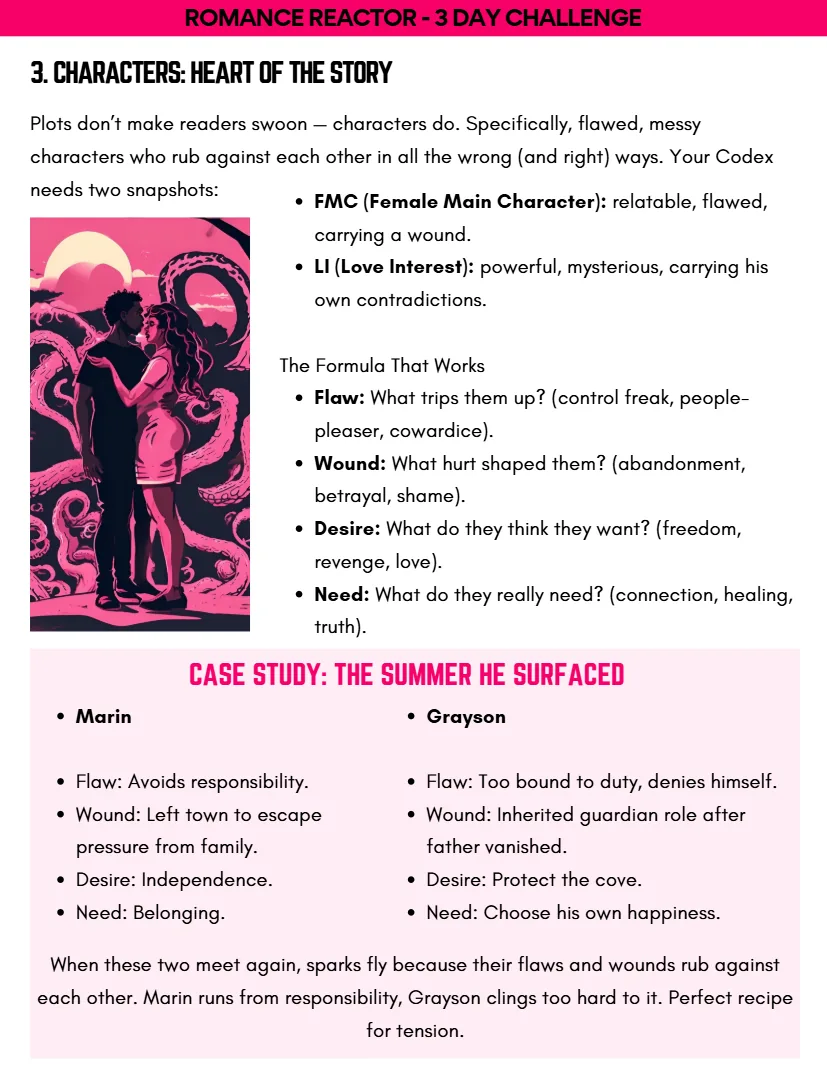
Inside, you build the Codex, map the six movements, watch the case study develop, and use the same scaffolding to draft your own story beside it. Five fill-in Tool Packets at the back take you from blank page to finished card.
THE PART THAT MAKES IT
SOUND LIKE YOU.
Left alone, AI writes in the blandest, most average version of English it knows. Because that's what average means.
Your Voice Card is the one page that tells it who's actually writing. Not artsy adjectives it will ignore — the measurable habits you already have and mostly can't see: how long your sentences run, how you start them, which punctuation you reach for, how often you compare one thing to another.
It takes about ten minutes to build at the end of Day 1. Then it rides at the top of every drafting prompt from Beat 1 onward, and you never build it again — not for this book, not for the next one.
The Chapter Card
When a beat runs long enough to split across two chapters, this is what keeps the book from contradicting itself. Three parts: what the chapter owes, what's already true, and what happens in it.
- What the reader knows that your heroine doesn't
- What's planted and still unpaid
- What can't be walked back
- Two prompts: one builds the card, one writes the chapter
You don't fill it out by hand. The prompt fills it. You spend a minute fixing what's wrong.

I DIDN'T DESIGN THIS FROM A WHITEBOARD.
I DRAFTED 30 BOOKS THAT WENT NOWHERE FIRST.
I had over 30 partially-drafted books sitting in folders before I built this.
Not outlines. Not ideas. Actual drafts, 20,000, 40,000 words in, that I'd started with an AI co-writer and then abandoned, because somewhere past the halfway point the story always lost the plot. Characters started repeating themselves. The middle sagged. What came out read like generic mush, and fixing it took longer than starting over. So I didn't fix it. I just started the next one.
I'd never studied writing before this. I thought I was just doing something wrong. So I went and read the craft books (Story Engineering, Truby's Anatomy of Story, the genre how-to shelf) to figure out what I was actually missing. What I found wasn't a technique gap. It was a context gap: all the story details I was holding in my own head without realizing it, who this character is, what they'd never say, what happened three chapters ago, the AI just doesn't have that. So I tried the obvious fix: a bigger story bible, Novelcrafter's codex system. And it backfired both directions. The AI got worse at focusing with all that extra context to hold, and I got worse at focusing too, trying to track my own notes on top of everything the AI filled in around my idea while it was helping me write it. That's what happens when you co-write with AI: it doesn't just type out exactly what you said, it fleshes it out, and now you're tracking that too.
The fix wasn't more context. It was a shorter book, short enough that neither of us loses the thread. That's Romance Reactor.
I've used this exact method to publish five-plus books on Amazon so far, in whatever spare time I've got outside everything else I run. One of them is still my favorite thing I've written. I write under a comedic/absurd romance brand myself (an alien crash-lands into Costco and thinks I'm his warrior bride), so I built this to flex across tone, not just one genre's formula.
I'd always wanted to write my own books. I just didn't have room for it on top of everything else, and it stayed a back-burner thing for years. I'm not saying that to take anything away from people who write by hand; that's a real skill and I'm not claiming otherwise. Writing with AI is just what finally gave me the time and space to actually do it. This method is what I built to make that time count.
THE BOOK TEACHES THE SYSTEM.
THE BONUSES MAKE IT EASIER TO USE.
Chapter 12 walks you through an editing pass in a deliberate order: a reader tells you how it lands, an editor tells you what's wrong on the page, then you go back in and make it yours.
Red Pen Rhonda
A romance reader who's had a couple of glasses of wine and lost her filter. She is not here to be nice. She's here to tell you where she got bored, where she got confused, and where she almost put the book down — then score your story out of 100.
- Reads your draft as a reader, not a critic
- Names the exact chapter she drifted in
- Holds you to your own Premise Card promise
- Use it: Chapter 12, Step 1
Polish & Publish AI Prompt
Rhonda tells you how the book feels. This tells you what's actually wrong on the page: continuity, logic, sentence rhythm, word choice — the things a reader doesn't consciously notice but absolutely feels.
- Audits your sentences and scores them out of 100
- Names the exact lines to fix
- Comes with the manual Polish & Publish Checklist if you'd rather do it yourself
- Use it: Chapter 12, Step 2
THIS ISN'T JUST A DRAFTING TOOL.
IT'S THE WHOLE PROCESS.
A Codex to keep the AI from losing the thread. A Voice Card so the draft sounds like you. A 6-beat structure to keep the middle from stalling out. Editor prompts to catch structural and prose problems before you call it done. And then the part most systems skip: an actual human pass.
Codex & Voice Card
Give the AI the context you're carrying in your head — and the way you actually sound.
6-Beat Draft
Structured short enough that neither of you loses the thread.
Editor Prompts
Red Pen Rhonda reads it like a reader. Polish & Publish audits it like an editor.
Marginalia
The human pass. Highlight a line, say what's off in plain language, turn it into a real revision.
Marginalia is what I built for that last step, so you can highlight a line on your phone from the porch or your desktop at 11pm, and turn a plain-language note into a real revision instead of a full rewrite. Early access is included with Romance Reactor. It's still getting its visual polish, but the workflow behind it is exactly what I use on my own books.
USE IT BESIDE THE AI TOOL
YOU ALREADY WRITE WITH.
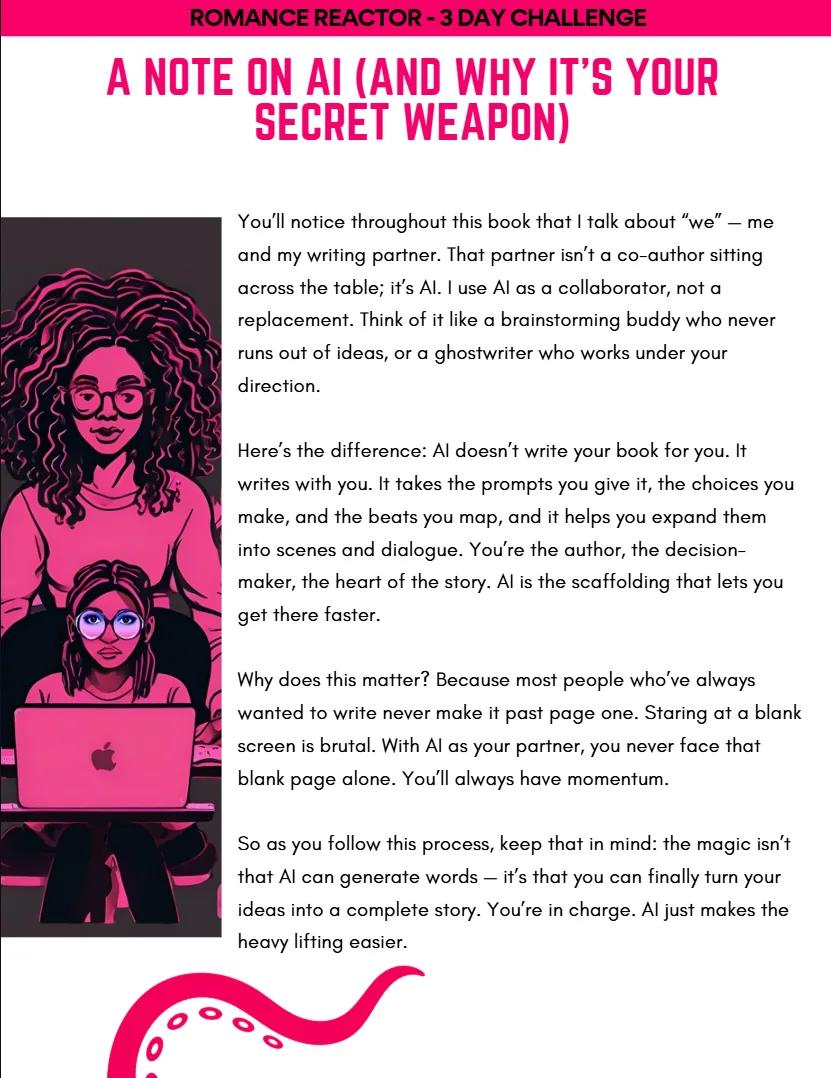
Romance Reactor is the story-planning and drafting layer. ChatGPT, Claude, Gemini, or another capable model becomes the drafting partner rather than the system making every creative decision.
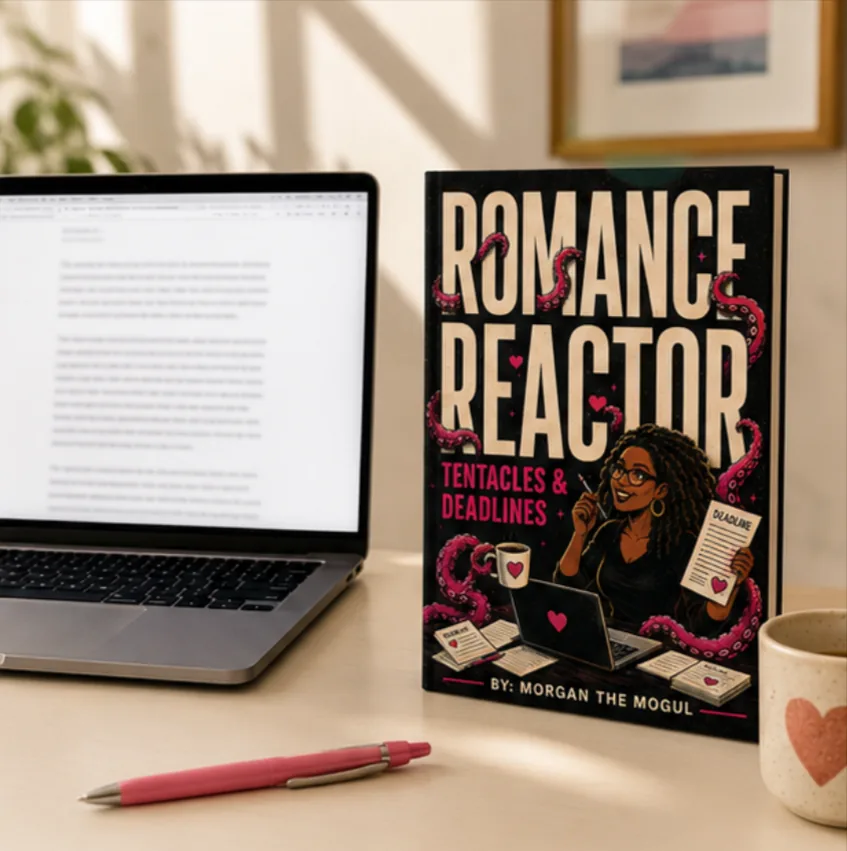
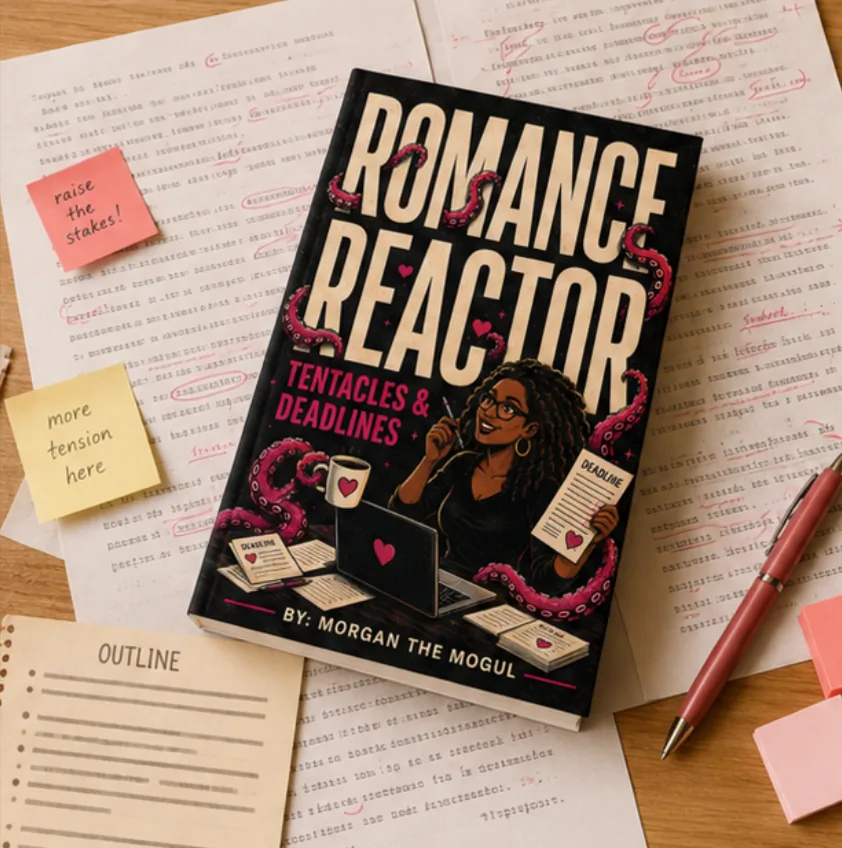
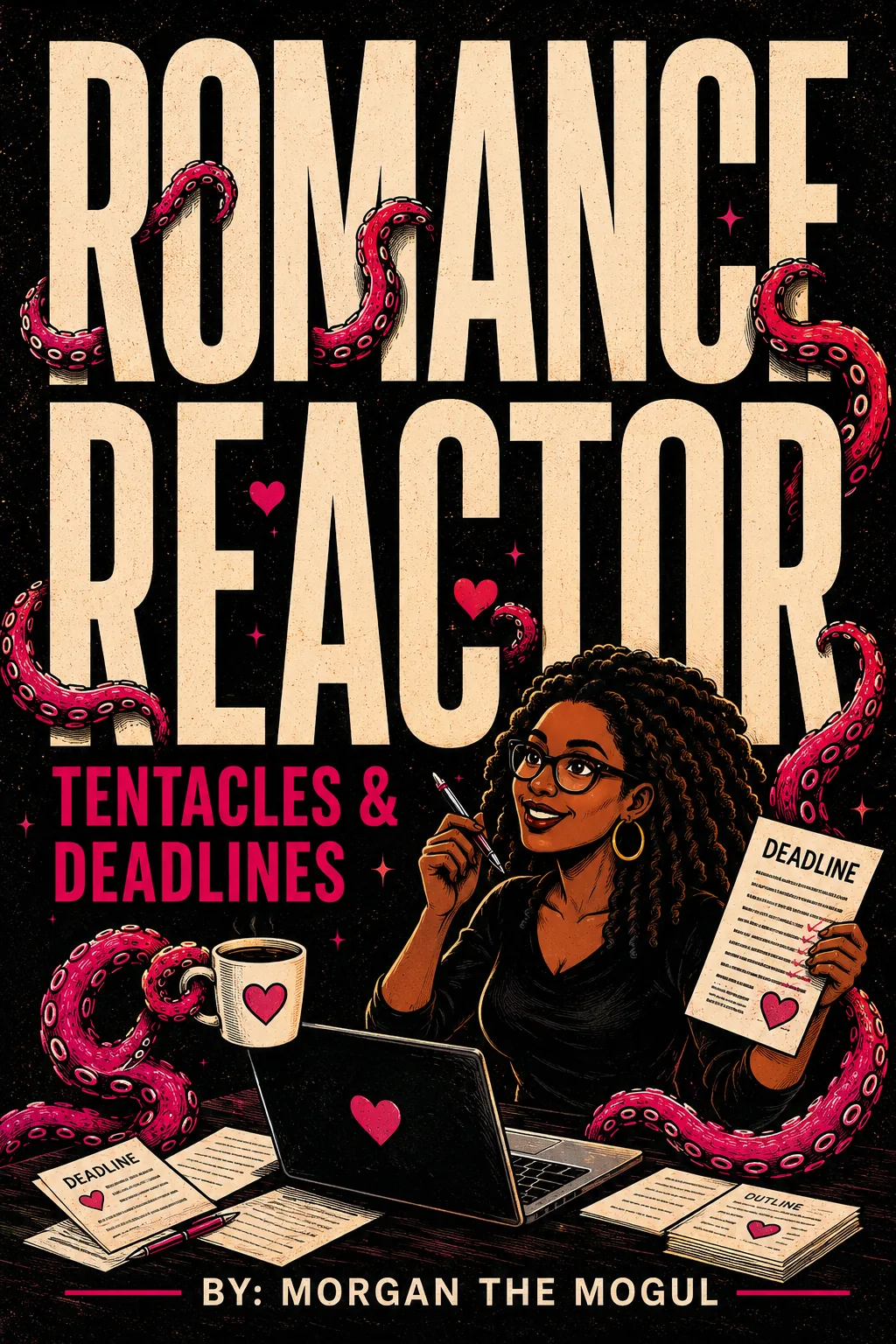
One payment. Instant digital access. $363+ in value.
Complete Your Order
BEFORE YOU START.
Do I need ChatGPT?
No. ChatGPT, Claude, Gemini, or another capable writing model can be used.
Does this only work for monster romance?
No. The Kraken romance is the running example. The underlying system works across romance subgenres.
What's the Voice Card, and do I need to be a "real" writer to build one?
No. The Voice Card is a one-page profile of how your prose actually behaves — sentence lengths, how you open sentences, your punctuation habits, how often you reach for a comparison. You build it in about ten minutes at the end of Day 1, either from writing you've already done or from a handful of published authors whose rhythm you want to borrow. It's measurable, not artsy, which is exactly why the AI can follow it.
I've already studied Save the Cat or romance beats. Is this redundant?
No. Traditional frameworks teach story structure. Romance Reactor focuses on translating that structure into explicit context AI can draft from.
Do I have to finish in exactly three days?
No. The guide is structured as a three-day challenge, but you can use three evenings, a weekend, or spread it across a week. The editing pass afterward has no clock on it at all — take it tomorrow, next weekend, or next month.
Why short romances instead of full-length novels?
Because the shorter format gives you more control over the middle. Instead of a stretch where the story has to invent reasons to keep going, this framework uses that space as an escalation point: raising the stakes instead of stalling them.
Is there actually demand for shorter romance right now?
Yes, and it's growing. Amazon's Short Reads category and the explosion of TikTok micro-dramas are both pointing at the same shift: readers wanting stories they can finish over lunch or in one sitting, not a 400-page commitment. That's not a niche preference anymore, it's a format readers are actively looking for, and it's early enough that there's still room to build a catalog in it.
I've bought writing courses or templates before and they didn't help. Why is this different?
Because most of those give you a framework and leave you to figure out the AI part alone, or give you an AI prompt and leave you to figure out the structure part alone. Romance Reactor is the two together: a 6-beat structure short enough that the story can't lose the thread, built specifically for how AI co-writing actually breaks (context loss, generic prose, sagging middles), with a Voice Card so it sounds like you, a prose-polish pass that catches the exact "written by a robot" tells, and editor prompts that read your draft before a stranger does. It's not a guarantee your book will be a bestseller. It's a method that gets you to a finished draft you're not embarrassed by, which, if you've got folders of unfinished ones, is the actual thing standing between you and publishing anything.
WRITE
THE END.
Three focused days. One couple. One complete short draft.
START YOUR ROMANCE REACTOR: $24.97